

During each two-year Congress, tens of thousands of bills are introduced on Capitol Hill. Only around 2-5% ever become law.
The bills that become law are rarely brand-new ideas. More often, they are proposals that have been introduced, revised, negotiated, amended, and reintroduced across multiple Congresses before finally crossing the finish line.
Congress is designed to move deliberately. The legislative process is built around review, debate, negotiation, and compromise. Strong ideas matter, but timing, relationships, committee priorities, political dynamics, and sustained engagement matter just as much.
Understanding how those pieces fit together can make the difference between a proposal that gains traction and one that stalls. At ESP Advisors, we help clients navigate this process by translating technical expertise into actionable legislative strategies and identifying opportunities to move priorities forward on Capitol Hill.
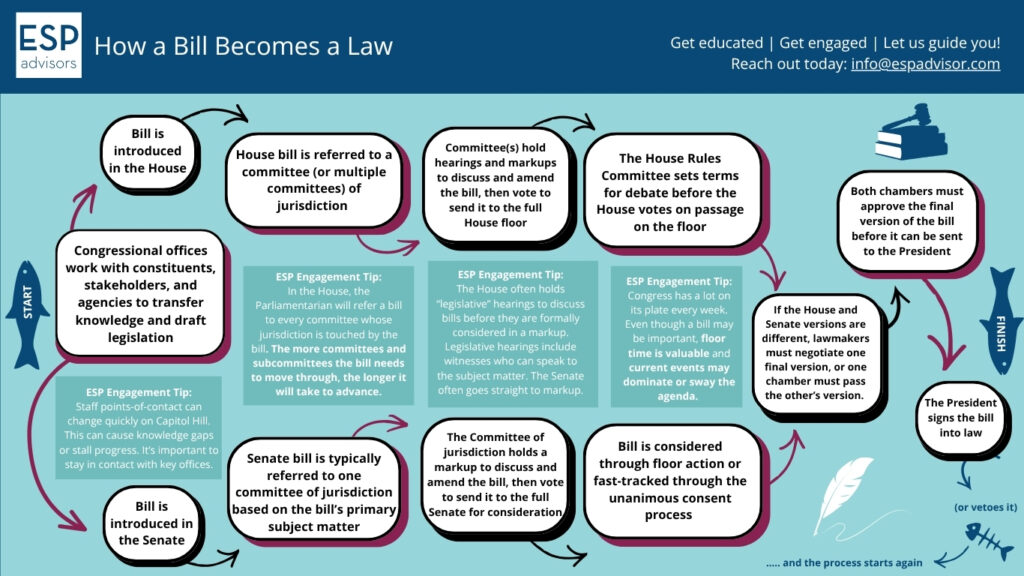
Click on the image to view the full process more closely.
Every Bill Starts with an Idea
Good legislation starts with a strong concept, but not every idea is ready for Congress. Congressional offices juggle countless competing priorities, and the proposals that gain attention are typically the ones that are clear, actionable, and tied to a broader policy need or constituent interest.
That means advocates need to translate expertise into language policymakers can quickly understand and act on. Members of Congress and their staff are constantly engaging with constituents, agencies, researchers, industry leaders, advocacy organizations, and subject-matter experts. Legislative priorities are shaped through these ongoing conversations long before a bill is formally introduced.
ESP Advisors works with clients during this early stage to help sharpen messaging, align ideas with congressional and federal priorities, identify potential champions, and position proposals for future legislative opportunities.
Timing Matters More Than Most People Realize
Even strong proposals can struggle to gain traction if the timing is off. Congress operates on a two-year cycle, and any bill that is not enacted by the end of a Congress must be reintroduced and start the process over again. Leadership priorities, committee bandwidth, appropriations deadlines, elections, and breaking news events all influence what moves and what gets delayed. A proposal may be introduced several times before conditions align for meaningful action. In some cases, provisions from standalone bills are eventually incorporated into larger legislative packages moving through Congress.
In practice, many successful legislative efforts are the product of persistence rather than a single breakthrough moment. Legislative packages can sometimes move quickly, but the ideas most likely to succeed are usually the ones that have already been vetted, refined, and socialized over time.
Turning an Idea Into Legislative Text
Once a Member of Congress decides to pursue legislation, the drafting process begins. The Member’s staff works with House or Senate Legislative Counsel (nonpartisan attorneys responsible for drafting legislation) to translate policy concepts into formal statutory language.
This process is highly iterative. Drafts often move through multiple rounds of revisions with congressional offices, agencies (via technical drafting assistance), stakeholders, and technical experts. Even minor wording changes can carry significant policy implications.
At this stage, congressional staff must answer practical questions such as:
- What exactly would the bill do?
- Which agencies would implement it?
- Would it authorize or direct funding?
- Does it create a new program or modify an existing one?
- Which committees would likely have jurisdiction?
The answers shape not only the policy itself, but also the bill’s potential path through Congress.
Committees: Where Most Legislative Work Happens
Once introduced, legislation is referred to committee by the Parliamentarian (nonpartisan advisors in each chamber who interpret congressional rules, advise leadership on legislative procedure, and help determine how legislation is referred to committees). Committees and subcommittees are where most of the substantive work in Congress takes place.
The committee process can significantly shape legislation. In the House, bills can be referred to multiple committees when the bill impacts multiple committees’ jurisdictions. The more committees involved, the more complicated and time-consuming the process becomes. In the Senate, the bill is most often referred to just one committee that holds jurisdiction over the majority of the subject matter in the bill. Building support within the right committee(s) is often one of the most important parts of advancing legislation.
If committee leadership and staff like the bill, the committee may hold hearings and/or markups on the bill. Hearings allow lawmakers to gather information from agencies, researchers, industry representatives, advocacy organizations, and the public. During markups, members debate legislation, offer amendments, and vote on whether to advance a bill. A bill must receive a majority vote in committee to move forward, and there is often an informal vote counting process before it is brought to markup to ensure its success.
Floor Consideration and Chamber Differences
Once a bill advances out of committee, it may move to the full House or Senate for consideration. To be considered by the full chamber often requires the committee chair and staff to advocate for the bill with House or Senate leadership, and a formal or informal vote count (or “whip”) to ensure the bill will pass if considered.
In the House, the Rules Committee typically determines how legislation will be considered on the floor, including how much debate is allowed and whether amendments can be offered. The Rules Committee may also amend the bill before it reaches the floor. Noncontroversial bills may be considered under a process called “Suspension of the Rules,” which limits debate, prohibits floor amendments, and requires a two-thirds vote for passage.
In the Senate, noncontroversial bills are often advanced through unanimous consent agreements or an informal process known as the “hotline,” where offices are notified of a bill and given the opportunity to object. If no Senator objects, it passes. If a bill must go to the Senate floor, the process becomes significantly more difficult and time-consuming. Unlike the House, the Senate allows extended debate through the filibuster, meaning most legislation effectively needs 60 votes to invoke “cloture” and end the debate, moving toward final passage. Even after cloture is invoked, Senate rules can require up to 30 additional hours of floor consideration before a final vote, making floor time one of the chamber’s most limited resources.
If both chambers pass legislation, they must still agree on identical text before the bill can be sent to the President. That may involve negotiating a compromise version, amending or passing one chamber’s bill, or incorporating provisions into a larger legislative package. Throughout the process, legislation is often revised, merged, or reshaped as priorities evolve.
The President’s Desk
Once both chambers pass identical legislation, the bill goes to the president’s desk. The president may sign it into law, veto it, or ignore it. If the president vetoes the bill, Congress can override the veto with a two-thirds vote in both chambers.
If the president takes no action, the bill automatically becomes law after 10 days (excluding Sundays) as if it had been signed. If Congress adjourns during that 10 day period, the bill fails without an opportunity for Congress to override the veto (also known as a pocket veto). Congress avoids pocket vetoes by scheduling the presentation of bills so the 10-day review period does not fall during a long adjournment, or by leaving an authorized agent, such as the Clerk of the House or Secretary of the Senate, to receive veto messages while chambers are out of session.
While presidential action receives the most public attention, most legislation never reaches that stage. The bigger challenge is typically sustaining enough support and momentum throughout the legislative process to keep a proposal moving. That requires ongoing engagement, strategic timing, and an understanding of how Congress operates in practice.
Why Engagement Matters at Every Stage
Introducing a bill is only the beginning. Legislation moves through a constantly shifting political environment shaped by elections, leadership priorities, budget negotiations, floor schedules, staff turnover, and current events. Sustaining momentum requires understanding where and when engagement matters most.
Effective legislative engagement often includes:
- Identifying and supporting champions in both chambers
- Coordinating stakeholder support and coalition efforts
- Providing technical feedback during drafting and markup
- Engaging committee leadership and staff early and often
- Monitoring legislative timing and procedural developments
- Identifying concerns early to minimize opposition
- Adjusting strategy as congressional priorities shift
Even bipartisan proposals can stall for reasons unrelated to the policy itself. Floor time is limited, committees face competing demands, and broader political dynamics can quickly change the legislative landscape. That is why successful legislative efforts often depend on a combination of strong policy ideas, sustained relationship building, strategic timing, and consistent engagement.
ESP Advisors helps clients navigate those moving pieces by crafting policy-ready ideas, drafting legislation, identifying opportunities for political alignment, building relationships and stakeholder support, and helping ensure the right information reaches the right offices at the right time.
On Capitol Hill, good ideas matter, but they rarely succeed without a deep understanding of the process and strong relationships with the decision-makers.
Learn more about how ESP can help you advance your legislative priorities at https://www.espadvisor.com/why-hire-esp/