50 Years of the Magnuson-Stevens Act 

Fifty years ago today, the Magnuson-Stevens Fishery Conservation and Management Act was signed into law by President Gerald Ford. For those working and living in the world of fisheries, everything traces back to one landmark piece of legislation. But what is the Magnuson-Stevens Act (MSA), and how does it advance American fishery management today? 

A Brief History 

Before 1976, fisheries management in the United States was fragmented and limited in scope. Federal jurisdiction extended only 12 nautical miles offshore, and management largely relied on state-level regulations that focused on measures like gear restrictions rather than comprehensive stock management. Beyond that boundary, foreign fleets operated with relatively little constraint, increasing pressure on fish stocks right off U.S. coasts.

The Magnuson-Stevens Fishery Conservation and Management Act, enacted in 1976, fundamentally changed that system. The law extended U.S. jurisdiction to 200 nautical miles offshore, establishing what is now the Exclusive Economic Zone (EEZ) and giving the United States clear authority to manage fisheries in those waters. 

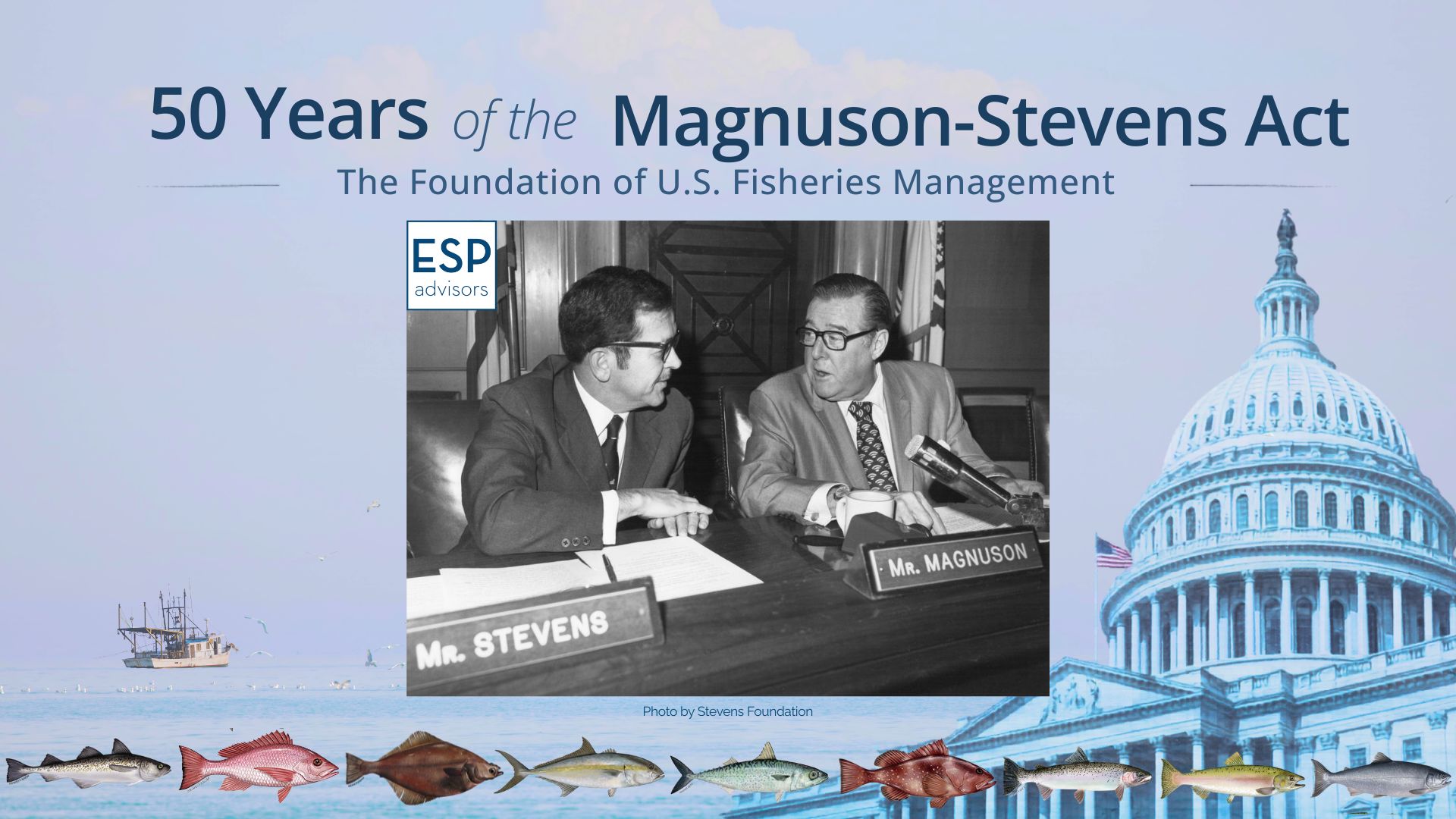
The Act was named for Senators Warren Magnuson (D-WA) and Ted Stevens (R-AK), and was led in the House by Rep. Don Young (R-AK-AL), who played leading roles in its development. The core objectives of the Act were preventing overfishing, rebuilding depleted stocks, and ensuring that fishery resources could support both ecological health and economic activity over time.

In the decades that followed, Congress updated and refined the law to strengthen its scientific and management foundations, through what is known as “reauthorization”. The Magnuson-Stevens Act has been reauthorized twice throughout its history. The 1996 reauthorization, the Sustainable Fisheries Act, introduced more explicit conservation requirements, including mandates to rebuild overfished stocks and protect essential fish habitat. It also expanded the law’s scope to account for fishing communities, bycatch, and safety at sea. The 2006 reauthorization marked another major step, requiring enforceable annual catch limits and accountability measures across federally managed fisheries. It strengthened the role of science in decision-making by formalizing the function of Scientific and Statistical Committees and reinforcing the requirement that management be based on the best available data. 

Today, the Magnuson-Stevens Act remains the central legal framework for marine fisheries management in U.S. federal waters. Congress is considering reauthorization and updates, but the law itself continues to guide how fisheries are managed in practice.

American Fisheries Management Today

The Magnuson-Stevens Act established a management system that is both regionally-led and federally overseen.

At the center of that system are eight regional fishery management councils. Each council is responsible for fisheries in a specific geographic area and includes members nominated by state governors and appointed by the Secretary of Commerce, along with state officials and representatives from the fishing industry and other stakeholder groups. This structure is designed to ensure that decisions reflect regional conditions and practical experience, not just national policy goals. These councils are responsible for developing Fishery Management Plans for the fisheries under their jurisdiction. Those plans set the rules that determine how fisheries operate, including how much can be caught, when and where fishing can occur, and what conservation measures are required to sustain fish populations over time.

While councils play a central role, they do not operate independently. The councils are required to provide multiple opportunities for public comment on fishery management plans, amendments, and regulatory changes. Public input is gathered through meetings, advisory panels, public hearings, and written submissions, allowing stakeholders to provide insight to help inform decisions on catch limits and conservation actions.

Additionally, the councils’ decisions are shaped by scientific input and subject to federal approval. Each council is supported by a Scientific and Statistical Committee, which provides guidance on stock status, sustainable catch levels, and scientific uncertainty. The law requires that management decisions be based on the best available science, and these committees are a key part of that process. All management plans must also comply with the Act’s National Standards, which establish baseline requirements for sustainability, fairness, efficiency, and environmental protection. These standards ensure that, despite regional differences, fisheries management across the country follows a consistent set of principles.

Once a plan is developed, NOAA Fisheries reviews it and implements it through federal regulation. NOAA is also responsible for monitoring fisheries, conducting stock assessments, and enforcing compliance. The result is a system in which responsibility is shared. Regional councils develop and propose management measures, stakeholders provide input, scientists provide the analytical foundation, and the federal government ensures consistency, oversight, and enforcement.

What’s Next for MSA?

There are a lot of different, and sometimes competing, ideas about how to improve and update the law to meet the current needs of fishermen, fisheries, and the seafood industry. Congress has dozens of bills under consideration that would change the law, which is currently expired as of 2013. Since the last reauthorization, disagreements about these changes have led to stalled reauthorization bills. On behalf of our clients, ESP Advisors helps to advocate for funding for NOAA Fisheries and legislation tweaks needed to keep U.S. fisheries strong.  
Monaliza Manalinding

Monaliza has over three years of experience supporting small businesses professionals and managing fast-paced administrative operations. She brings strong skills in client relations, scheduling, and marketing support, ensuring efficient workflows and exceptional service across all facets of the firm.

FAVORITES

Ginger Tea

Sea turtles

Based in Philippines

Marianne Brisson

Marianne helps mission-driven organizations scale their impact through streamlined operations, project leadership, and strategic communications. She leads ESP’s day-to-day operations and ensures firm-wide success. Marianne previously served as Policy and Operations Advisor to the Minister of Fisheries, Oceans and the Canadian Coast Guard.

FAVORITES

Hot latte with oatmilk

Nudibranch

Based in Oregon

Mike Henry

Mike Henry is a Washington, D.C.-based science and technology policy leader focused on weather, water, and ocean advocacy. He has shaped federal science policy through roles at UCAR, NASA, and the American Institute of Physics, and began his career on the Senate staff of Sen. Ben Cardin.

FAVORITES

Green Tea

Blue Crab 

Based in DC

Pamela Day Tapscott

Pamela Day has over 25 years of experience on Capitol Hill. As Chief of Staff for the late Congressman Don Young (R-AK), father of many initiatives and laws that govern ocean resources today, Pamela managed the annual appropriations process and oversaw 16 original bills that were signed into law.

FAVORITES

Coffee

Otter

Based in Maryland

Angelo San Pablo

Angelo San Pablo is an ocean policy professional with experience in federal agency engagement, congressional advocacy, and seafood policy. He recently supported senior leadership and congressional affairs at NOAA Fisheries, and he also has climate experience spanning coordination and finance.

FAVORITES

Mocha latte with oat milk

Blue whale

Based in DC

Caroline Roche

Caroline brings sharp policy instincts and a passion for coastal resilience to ESP Advisors. At the White House Council on Environmental Quality, she supported both the freshwater and ocean policy teams. Most recently, she worked on communications and government affairs for Restore America’s Estuaries, deepening her expertise in habitat protection and federal engagement. Caroline holds a dual degree in Political Science and Fine Art from George Washington University.

FAVORITES

Unsweetened Iced Green Tea

Beluga Whale

Based in DC

Rachael DeWitt

Rachael DeWitt’s expertise spans from freshwater to ocean conservation and policy. She most recently worked for Ocean Conservancy on its government relations team, covering issues including Arctic conservation, fisheries, climate, ocean energy, deep-sea mining, and shipping. On Capitol Hill, Rachael worked for Representative Jared Huffman (D-CA) on ocean policy issues. Previously, she served as Executive Director of the Skaneateles Lake Association in upstate New York.

FAVORITES

Flat white

Juvenile boxfish

Based in NY

Austen Stovall

Austen Stovall’s background is in coral reef ecology, nature-based solutions, and coastal management. She most recently worked for Representative Jared Huffman (D-CA-02) on his oceans and fisheries portfolio. Austen holds a master’s degree in coastal science and policy from UC Santa Cruz.

FAVORITES

Iced oat milk latte with coconut syrup

Corals

Based in DC

Kat Montgomery

Kat draws upon her ocean policy expertise and years of experience managing projects, programs, and teams to catalyze success for ESP Advisors and our clients. Most recently, Kat served as staff for Senator Roger Wicker (R-MS), former Chair of the Senate Committee on Commerce, Science, and Transportation.

FAVORITES

Cappuccino with sugar

Seahorse

Based in Virginia

Emily Patrolia

Emily Patrolia founded ESP Advisors to address the need for sophisticated government and public affairs services in the community she holds dear. Emily uses her advocacy and congressional experience and deep understanding of environmental science to lead the firm in all its endeavors.

FAVORITES

Cappuccino

Yeti crab

Based in DC

Angelo San Pablo

Angelo San Pablo is an ocean policy professional with experience in federal agency engagement, congressional advocacy, and seafood policy. He recently supported senior leadership and congressional affairs at NOAA Fisheries, and he also has climate experience spanning coordination and finance.

FAVORITES

Mocha latte with oat milk

Blue whale

Based in DC

Rachael DeWitt

Rachael DeWitt’s expertise spans from freshwater to ocean conservation and policy. She most recently worked for Ocean Conservancy on its government relations team, covering issues including Arctic conservation, fisheries, climate, ocean energy, deep-sea mining, and shipping. On Capitol Hill, Rachael worked for Representative Jared Huffman (D-CA) on ocean policy issues. Previously, she served as Executive Director of the Skaneateles Lake Association in upstate New York.

FAVORITES

Flat white

Juvenile boxfish

Based in NY

Mike Henry

Mike Henry is a Washington, D.C.-based science and technology policy leader focused on weather, water, and ocean advocacy. He has shaped federal science policy through roles at UCAR, NASA, and the American Institute of Physics, and began his career on the Senate staff of Sen. Ben Cardin.

FAVORITES

Green Tea

Blue Crab 

Based in DC

Marianne Brisson

Marianne helps mission-driven organizations scale their impact through streamlined operations, project leadership, and strategic communications. She leads ESP’s day-to-day operations and ensures firm-wide success. Marianne previously served as Policy and Operations Advisor to the Minister of Fisheries, Oceans and the Canadian Coast Guard.

FAVORITES

Hot latte with oatmilk

Nudibranch

Based in Oregon

Monaliza Manalinding

Monaliza has over three years of experience supporting small businesses professionals and managing fast-paced administrative operations. She brings strong skills in client relations, scheduling, and marketing support, ensuring efficient workflows and exceptional service across all facets of the firm.

FAVORITES

Ginger Tea

Sea turtles

Based in Philippines

Sarah Keartes

Sarah brings a decade of media relations and science communication expertise to her role at ESP Advisors. Before joining ESP, she reported on marine and coastal science for outlets including National Geographic News, PBS Digital Studios, and Hakai Magazine.

FAVORITES

Iced tea

Scalloped hammerhead

Based in Oregon

Cat Elia

With over a decade of experience bringing clients’ visions to reality, Cat specializes in marketing and brand development. As both a designer and artist, she excels in visual storytelling and graphic strategy.

FAVORITES

Iced coffee with milk

Frog fish

Based on the West Coast

Caroline Roche

Caroline brings sharp policy instincts and a passion for coastal resilience to ESP Advisors. At the White House Council on Environmental Quality, she supported both the freshwater and ocean policy teams. Most recently, she worked on communications and government affairs for Restore America’s Estuaries, deepening her expertise in habitat protection and federal engagement. Caroline holds a dual degree in Political Science and Fine Art from George Washington University.

FAVORITES

Unsweetened Iced Green Tea

Beluga Whale

Based in DC

Austen Stovall

Austen Stovall’s background is in coral reef ecology, nature-based solutions, and coastal management. She most recently worked for Representative Jared Huffman (D-CA-02) on his oceans and fisheries portfolio. Austen holds a master’s degree in coastal science and policy from UC Santa Cruz.

FAVORITES

Iced oat milk latte with coconut syrup

Corals

Based in DC

Kat Montgomery

Kat draws upon her ocean policy expertise and years of experience managing projects, programs, and teams to catalyze success for ESP Advisors and our clients. Most recently, Kat served as staff for Senator Roger Wicker (R-MS), former Chair of the Senate Committee on Commerce, Science, and Transportation.

FAVORITES

Cappuccino with sugar

Seahorse

Based in Virginia

Emily Patrolia

Emily Patrolia founded ESP Advisors to address the need for sophisticated government and public affairs services in the community she holds dear. Emily uses her advocacy and congressional experience and deep understanding of environmental science to lead the firm in all its endeavors.

FAVORITES

Cappuccino

Yeti crab

Based in DC

tttttttt

We are a small but mighty team working to build a culture that leans into vulnerability, clarity, integrity, and transparency. Open communication, collaboration, and relationship building are of the utmost importance to our team. While our work is hard-charging and relies on exceptional attention to detail and deadline management, we remain dedicated to the wellbeing of our staff. Our goal is to ensure our team members are fulfilled both personally and professionally.

PAMELA DAY TAPSCOTT

Pamela Day has over 25 years of experience on Capitol Hill. As Chief of Staff for the late Congressman Don Young (R-AK), father of many initiatives and laws that govern ocean resources today, Pamela managed the annual appropriations process and oversaw 16 original bills that were signed into law.

FAVORITES

Coffee

Otter

Based in Maryland